
Titanium sounds like the obvious choice for a high-performance silencer. Lightweight, strong, premium. We thought so too — which is why we previously used it in our X-series.
But after years of real-world use, we moved away from it. Not because titanium is a bad material. But because for a silencer that goes through extreme heat and cold cycles, there are better options.
Here is what we learned, and why our silencers today are built from stainless steel and aluminium instead.
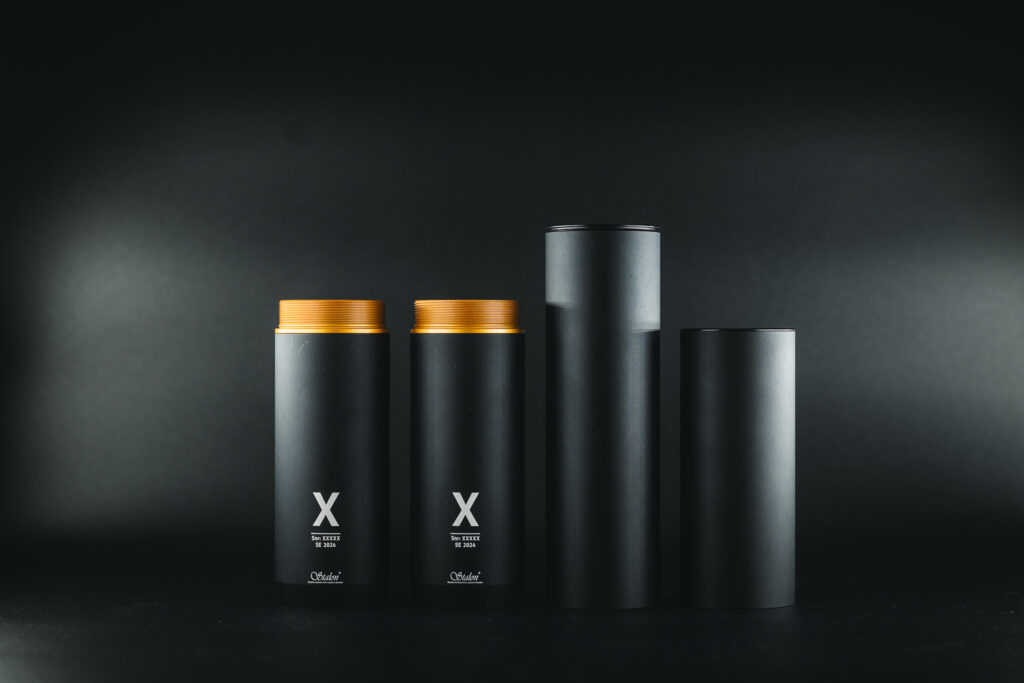
WHAT IS WRONG WITH TITANIUM IN A SILENCER?
Titanium has real strengths. It is light, corrosion-resistant, and looks great on a spec sheet. For many applications, it is an excellent material.
But silencers live in a tough environment. Every shot sends a burst of extreme heat through the baffle stack, followed by rapid cooling. Over time, this repeated thermal cycling causes a phenomenon called crystallisation — structural changes at the material level that increase the risk of crack formation.
Titanium handles static stress well. It handles dynamic thermal stress less well. That is the core problem.
How heat moves through a silencer
Select a shooting state below to see how thermal load travels through the baffle stack — and why material choice at the first baffle is critical.
ⓘ Stalon silencers use a stainless steel first baffle to protect the aluminium body from muzzle flash during intensive shooting. Same weight as titanium — greater thermal reliability.
WHY WE CHOSE STAINLESS STEEL INSTEAD
Our current silencers use a combination of stainless steel and aluminium — and the weight is the same as when we used titanium. That was a deliberate engineering goal: maintain the weight advantage without inheriting titanium’s thermal weaknesses.
Titanium vs aluminium silencer: a practical comparison
| Property | Titanium | Stainless steel + aluminium |
|---|---|---|
| Weight | Light | Same as titanium (by design) |
| Thermal cycling reliability | Crystallisation risk over time | Stable under repeated heat/cold |
| Muzzle flash resistance | Moderate | High (stainless first baffle) |
| Crack formation risk | Higher with extended use | Lower |
| Manufacturing precision | Challenging | Well-established tolerances |
THE FIRST BAFFLE: STAINLESS STEEL
The first baffle sits at the front of the silencer, closest to the muzzle. This is where temperatures are highest. During intensive shooting, muzzle flash from a rifle is hot enough to melt aluminium at that proximity.
By using stainless steel for this specific component, we protect the aluminium body from burn-out where the heat is most intense. The stainless baffle acts as a thermal shield.
THE BODY: ALUMINIUM
The main body uses aluminium — a material that is well-understood, predictable under thermal stress, and easier to manufacture to tight tolerances. When the critical heat exposure point is protected by stainless steel, aluminium performs reliably across the rest of the structure.
Two components. Two materials. One reason.
The first baffle
Stainless steelPositioned closest to the muzzle, the first baffle takes the full force of every shot. Muzzle flash from a rifle is hot enough to melt aluminium at this proximity — stainless steel handles it without degrading. It acts as a thermal shield for everything behind it.
Hover to learn more
The body
AluminiumWith the first baffle absorbing the most intense heat, the aluminium body operates in a protected zone. Aluminium is lightweight, precise to manufacture, and performs reliably under the thermal conditions it actually faces. The result: same weight as titanium, greater long-term stability.
Hover to learn more
Good silencer design is not about using the most exotic materials. It is about understanding what each material does under actual conditions, and engineering accordingly.
We moved away from titanium not because it failed, but because we found a smarter solution. Same weight, more reliable performance, better thermal resistance where it counts.
Titanium vs aluminium silencer
Straight answers about silencer materials, heat resistance, and why we changed our design.
titanium silencer · aluminium silencer · stainless steel silencer · silencer materials · silencer baffle · muzzle flash · rifle silencer · gun suppressor · firearm moderator · silencer construction · thermal resistance · silencer design · hunting silencer · Stalon silencer · Stalon X


