Mesures de bruit

Découvrez comment nous mesurons le bruit

Sound Reduction – Stalon Silencers

Sound Reduction

Real test data from Stalon's lab measurements. Select a caliber to see average dB reduction per model.

Bolt action
VRXSXXE
Semi-automatic (Venti)
VR VentiXS VentiX VentiXE Venti

Sound measurements

What is noise, and how do we measure it?

MIL-STD-1474D – our "MIL standard" – is the method we rely on for all sound measurements. By following this military specification precisely, we can present honest, repeatable and comparable data for every Stalon silencer.

Stalon noise measurements

The basics

What does a silencer actually reduce?

Click to explore each source of noise

The typical sound or noise from a firearm is generated from two things. The first is a sudden release of hot, high-pressure propelling gases in the bore, and the other is the sound of the bullet in flight (sonic boom).

The noise from the sonic boom is generated at a far distance outside of a firearm and cannot be addressed by the silencer. The sound from the bullet's supersonic speed or when the bullet hits something has a higher noise level than many expect — illustrated when shooting in an open field compared to a deep forest, where sound bounces back with higher force.

The noise generated from the release of hot, high-pressure gases comes from the actual gunpowder explosion. These gases have extremely high pressure and create an impulse sound when leaving the barrel. A silencer reduces this by slowing down and reducing pressure on the gases before they are released into the atmosphere.

The standard

Having a reliable result

Why methodology matters more than a single dB number

MIL-STD-1474D specifies the exact procedure and how to perform the test, including sound level meter type, microphone positions, operator positions, surroundings, and more. Stalon AB uses this method for all noise measurements with an exact setup according to the terms of the standard.

Something important to understand when comparing silencers is how the actual noise measurement was executed and why. This standard specifies the exact positions for every module and technical equipment used in the test.

MIL-STD-1474D measurement setup

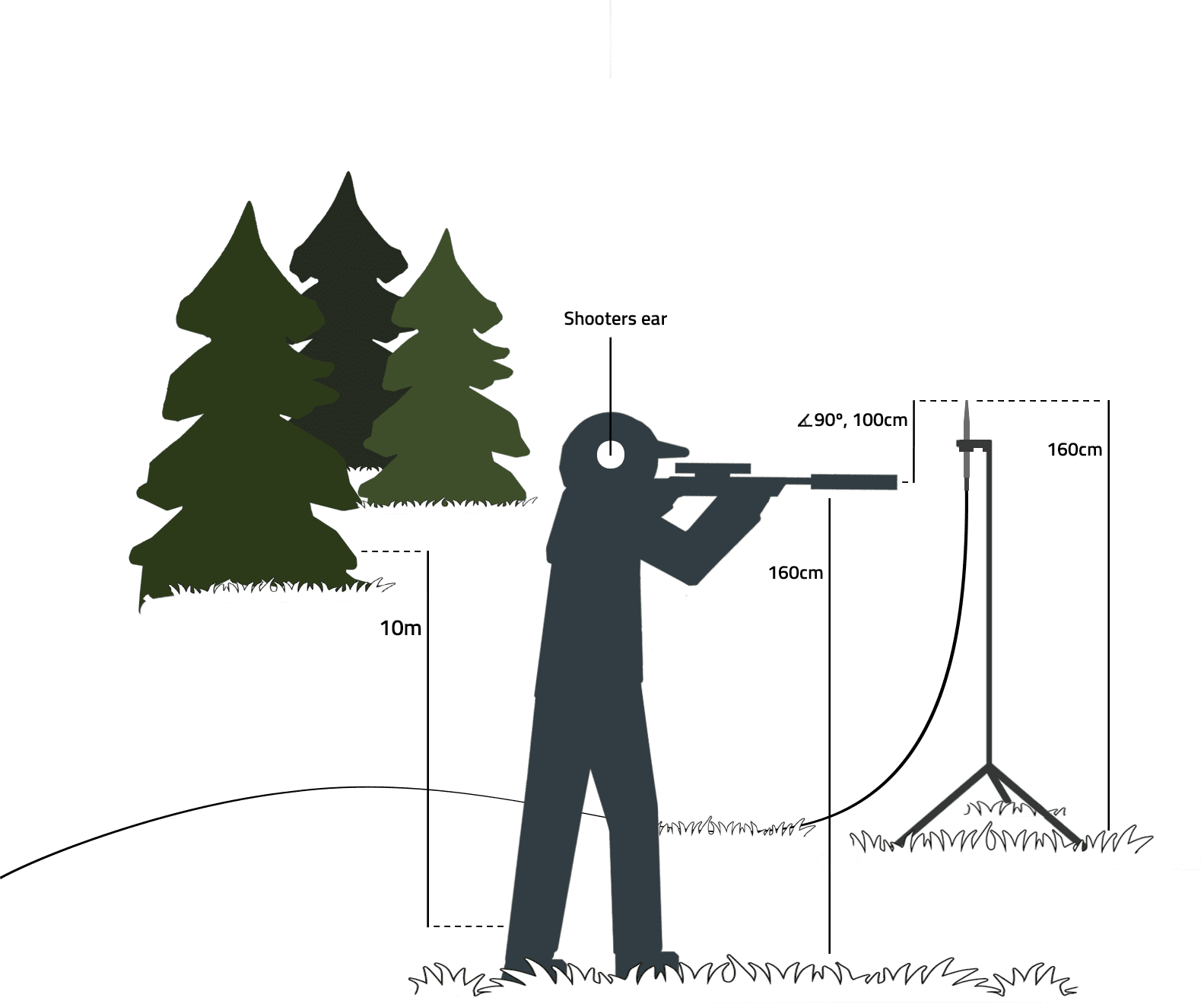
Noise is measured with a sound level meter positioned 100 centimeters and 90 degrees to the left from the bore exit of the silencer. If you like, you can add a reference position at "shooter's ear," which will make the result about 8–10 dBc lower.

Measuring at "shooter's ear" becomes a problem for several reasons. The space between the meter and the silencer's muzzle will affect the result significantly. A short but efficient silencer tested with a short barrel may appear noisier than a longer, less efficient silencer tested with a longer barrel — purely because of distance to the microphone.

VICTOR141 dBc (MIL) → 132 dBc at shooter's ear
XE149132.5 dBc (MIL) → 123.5 dBc at shooter's ear
Mic position100 cm / 90° left from bore exit, 160 cm above grass

Where we place the microphone

Our standard

How we position the microphone – every single time

MIL-STD-1474D measurement position
Primary position
90° · 100 cm left from bore exit · 160 cm above ground
← Stalon uses this
Shooter's ear (reference)
15 cm from bore axis · approx. 8–10 dBc lower · not a performance measure

Primary measurement position

MIL-standard specifies the noise meter placed at a 90-degree angle, 100 cm left from the bore exit of the silencer. Both the silencer and the noise meter should be 160 cm above short-cut grass.

This position provides the actual noise reduction of the silencer — independent of barrel length or body geometry.

Primary measurement position

"Shooter's ear" as reference

The noise meter is placed 15 cm from the bore axis, at the shooter's head. This position does not consider the length of the barrel or silencer — the further the meter from the muzzle, the lower the reading.

This is not an accurate way of measuring silencer performance, but can be used as a reference for the user's noise exposure.

Shooter's ear position
Equipment and data

All Stalon silencers are tested and measured according to MIL-STD-1474D at a 90-degree angle, 100 cm left from the bore exit of the silencer. The quality and regularity of all our noise level measurements are therefore 100% true.

Equipment we use:
  • Meter: Larson Davis LXT1 QPR, Digital, High precision (Type 1)
  • Detector: Larson Davis, Peak, High pressure, Range: 54 dB to 185 dB

Transparency

Raw test data

Click a model to see every individual test session

Context

How loud is it, really?

See where a suppressed shot lands on the scale of everyday sounds

Based on MIL-STD-1474D measurements. Unsuppressed reference: ~165 dBc (.308 Win).

Our conclusion

Why we use MIL-standard – and how to read any other number

After years of testing, we have tried every method available. Our conclusion is clear: MIL-STD-1474D gives the most honest and repeatable result.

The MIL standard fixes every variable – microphone distance, angle, height above ground, surface type. That means two different silencers tested on two different days in two different places can still be directly compared. No other method offers this.

Measurements at the shooter's ear sound attractive because they reflect the user's experience – but they are heavily influenced by barrel length and body position, not just the silencer. A longer rifle will always read lower at the shooter's ear, regardless of how effective the silencer actually is.

MIL-STD-1474D
100 cm · 90° from bore exit · 160 cm above ground. Stalon reports all results this way. This is the silencer's true performance.
Shooter's ear
Varies with barrel length and body geometry. As a rule of thumb: subtract roughly 10 dBc from a MIL result to estimate what the shooter experiences.
−10 dBc
A quick, reliable way to convert any MIL result to a shooter's ear estimate. For example: XE149 measures 132 dBc at bore exit → approximately 122 dBc at the shooter's ear.

Why trust us

Our commitment to honest data

100%
of measurements follow MIL-STD-1474D exactly
Type 1
High-precision Larson Davis LXT1 QPR used in all tests
185 dB
Maximum detector range — no clipping, no data loss
1 position
One fixed mic position every time — all variables removed

EN SAVOIR PLUS SUR LE BRUIT

Chez Stalon, nous pensons que des produits performants naissent de personnes de valeur. Notre équipe ne se résume pas à des ingénieurs et des chasseurs – nous sommes une famille bâtie sur des valeurs partagées de confiance, de dévouement et de passion pour la nature. Chaque idée, chaque conception et chaque silencieux que nous créons est le résultat d’une collaboration étroite et d’un engagement envers l’excellence.

Ce qui nous unit, ce n’est pas seulement notre savoir-faire, mais aussi notre respect de la nature et des traditions de chasse qui inspirent tout ce que nous faisons. En travaillant ensemble, nous nous assurons que chaque produit portant le nom Stalon est une source de fierté pour nous tous – un véritable reflet de qui nous sommes.

DÉCOUVREZ LA

PRÉCISION DE STALON
PAR VOUS-MÊME